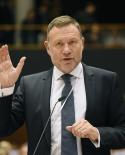
The European Committee of the Regions' 123rd Plenary Session takes place on 11-12 May 2017. With European Parliament elections set to take place in 2019, Antonio Tajani, the President of the European Parliament, will address members on the need to reconnect with the 508 million citizens living and working in Europe's regions and cities by showing the EU's added value on the ground. This address will be made in the context of the CoR's "Reflecting on Europe" initiative, which aims to give citizens the opportunity to share their concerns and expectations for the past, present and future of Europe.
Shortly ahead of adopting the CoR Resolution on the European Commission's White Paper on Europe, European Commission Vice-President Jyrki Katainen will speak about the latest developments, including the reflection paper on harnessing globalisation by 2025.
The future of Cohesion policy is a major priority for the CoR, with EPP Group President Michael Schneider's presenting his opinion which will formalise the CoR's official position. The demand for a strong cohesion post 2020 will be expressed on the Plenary's second day when a Resolution on the Draft Annual EU Budget for 2018 is set to be adopted.
The President of the Congress of the Council of Europe, Gudrun Mosler-Törnström, will also be present for a debate about democracy, the rule of law and freedom and the CoR will adopt a referral opinion on island economies, as a formal contribution to the Maltese Presidency of the Council.
Reflecting on Europe: European Parliament President joins CoR plenary for the first time
President Tajani will share his conviction that Europe needs to reconnect with citizens, during his first visit to the CoR plenary. Following his election in January 2017, President Tajani has repeatedly insisted on the need for Europe to deliver results. "Unity is indispensable if we are to tackle illegal immigration, guarantee security, reduce unemployment and promote stability and our values around the world… The people of Europe have elected us. As a result, we have to pave the way towards a Europe that is closer to its people" he said at the Conference of Speakers of the EU Parliaments in Bratislava in April.
All three of the main EU institutions are working to steer this discourse: the European Council launched its CoR members will debate with the EU leader on the past, present and future of the European Union and outline their commitment to bridging the gap between Europe and its citizens through the "Reflecting on Europe" initiative. As the two EU institutions with a direct link to the citizens, the European Committee of the Regions and the European Parliament have a pivotal role in restoring citizens' trust and help build a consensus about Europe's future.
EC White Paper on the Future of Europe – "Harnessing globalisation by 2025"
The recently adopted Declaration of Rome co-signed by all 27 Member States and Presidents of the main EU Institutions makes a plea for a better listening of citizens' concerns whilst stating that they "will work together at the level that makes a real difference, be it the European Union, national, regional, or local, and in a spirit of trust and loyal cooperation, both among Members States and between them and the EU institutions, in line with the principle of subsidiarity". This agreement was followed by a letter from European Commission President, Jean-Claude Juncker, and First Vice-President Frans Timmermans asking for the CoR's views on the White Paper.
European Commission Vice-President, Jyrki Katainen, will give a statement addressing the EU's regional and local representatives, including on the European Commission's reflection paper on harnessing globalisation by 2025, which is due to be published on 10 May 2017.
The White paper on the Future of Europe sets out five different scenarios of possible future developments. During the May plenary session the CoR will adopt a resolution which looks at the horizontal issues raised by the White Paper from a local and regional perspective. The CoR will later respond to the more detailed proposals on the key thematic priority areas identified! by the European Commission and then make its own proposal for the future of Europe in the own-initiative opinion "Reflecting on Europe" prepared jointly by the Committee's President and 1st Vice-President.
What future for Cohesion Policy beyond 2020?
Given its weighty importance, the first issue up for debate at the Plenary session is the timely opinion by rapporteur Michael Schneider (DE/EPP) on the future of cohesion policy. Cohesion policy is the biggest investment plan (accounting for around a third of the total budget) in the EU's tool box that reaches out to each and every corner of the EU. It promotes economic, social and territorial cohesion, which is why it is of such great importance that local and regional governments' voices are heard in the debate on its future.
To make cohesion policy more effective, the draft opinion seeks to make it more flexible by allowing operational investing priorities to target specific challenges as they emerge, such as migration, natural disasters, changes in demographics; make it easier to gain access to funds, by reducing bureaucracy and shifting priorities to actual impact of projects; and hopes to make it more connected, by strengthening the links to other EU policies. The opinion set the CoR's position to be fed into the upcoming EU-level debate and informal ministerial meetings and the 7th Cohesion report for September 2017.
Debate on the EU budget
EU regions and cities contribute to the development of a sustainable economy by building and renewing infrastructure, identifying and removing obstacles to investments and creating more synergies in the use of public and private sources. Within this context, the CoR believes that a strong cohesion policy must be adequately reflected in the future EU budget post 2020. This will be the main message in a debate with Günther Oettinger, European Commissioner for Budget & Human Resources.
Moreover, with Brexit negotiations gaining speed, the CoR will ask about economic implications for EU regions and cities on the current MFF and future budgetary resources. How local and regional authorities can benefit from the current and future EU budget, as well as ways to contribute to its effective implementation will also be on the table.
The CoR Resolution on the Draft Annual EU Budget for 2018, to be adopted at the May Plenary Session, is an opportunity to state the CoR's position with respect to the issues to be tackled in 2018. The resolution will set out recommendations to ensure that the interests of local and regional authorities are taken into account within the framework of the EU budget for 2018.
Following the conference on the topic a day ahead, the European Committee of the Regions is also to adopt Roberto Pella's opinion on the Health in Cities: the common good.