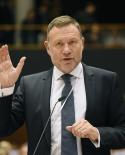
Michael Schneider, President of the EPP group in the European Committee of the Regions, welcomes UK Prime Minister Theresa May's announcement of the UK's objectives for the Brexit negotiations. "We have new elements that were clarified, and this helps to limit speculation over what the UK wants. However, I cannot say we have sufficient clarity over all the issues".
Although a clear position to exit the internal market has been mooted, there appears also the wish to maintain only the benefits and advantages of the internal market for goods and services - notably financial services. "Access through the back-door to only a part of the four freedoms which compose the single market is not acceptable. It is the famous and unfair 'cherry-picking' that the 27 Member States are united against".
The EU should start negotiations immediately once Article 50 is triggered by the UK. For the EPP-CoR President, these negotiations must be conducted fairly on both sides. It is about constructive talks towards an amicable solution for all and not a 'winner takes all' poker game. This means avoiding the use of inflammatory rhetoric and allegations.
President Schneider insists that the key is to reach results in a timely manner, thus minimizing economic and social damage both to the UK and the EU. "Our economies are closely linked in a globalized world, and it would be foolish to think that in future, these economies could each go their own way without some repercussions. We must ensure that the EU and the UK, in forging a successful new relationship, work closely together in partnership for our economies, in improving our research and innovation capacities and ensuring the security of our citizens" he stated.
Micheal Schneider is convinced that the EU and the UK will remain close partners beyond Brexit. "Ultimately, we are ready for a fair deal, but a fair deal means it is fair for the European Union too. We need to discuss further what fair really means" he concluded.
The leader of the EPP Group in the EU's assembly for local and regional authorities believes that in times of global challenges, and faced with uncertainty over the political direction of Europe's greatest Trans-Atlantic partner, classical western democracies have to work more in unison to overcome the challenges the future will bring for all.