Declaration signed by 334 regions across Europe calling for the prolongation of regional funding for all regions and the preservation of an own EU-policy for regions beyond2020 was given to the EU Commissioner for Regional Policy Corina Creţuand MEP Iskra Mihaylova, REGI committee Chair yesterday by the representatives of EU's regions and cities.
This Europe-wide bottom-up regional initiative at the highest political level was complimented by a conference on the Contribution of Europe's Regions to Managing our Future, organised in the premises of the European Committee of the Regions.
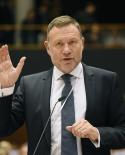
Moderating the event, EPP-CoR Group President and CoR's rapporteur on the Future of the Cohesion Policy beyond 2020, Michael Schneider expressed his gratitude for such a strong, joint voice of many local and regional representatives: "Today is a big day for the EU regions. The presence of so many and the support for the paper on Cohesion Policy show our unity. The debate on the future cohesion policy will not only be lead by its friends but also its opponents. Our position is that cohesion policy represents the diversity in Europe. The Commission defines the legal framework and rules, but the regions and cities decide where to invest. The question should be how to improve it in the future".
CoR President Markku Markkula, opening the event, stressed that "for every euro invested through the previous programming period of Cohesion Policy, 2.74 euros will be generated by 2023 - a return of 1 trillion euros. So we must be in no doubt that cohesion policy is worth every cent".
A message warmly welcomed by the main organiser behind the initiative, CoR Member Erwin Pröll, Minister-President of Lower Austria: "It is an honour and clear sign that so many regions, authorities and interregional organisations have joined this initiative as equal partners. The signatures and travelling of so many regional political representatives from all Member States to Brussels is the visible proof of the extraordinary importance of EU Regional Policy for all regions. Considered in a democratic Europe, both of these elements are binding on both EU legislators, the Council and Parliament in their future decisions on the multiannual financial framework post 2020".
Witold Stępień, Marshal of Łódzkie region from Poland raised a call for more bottom-up approach in the new framework: "While planning the shape of the new regulations, we need to secure also their mechanisms, thanks to which cohesion policy implementation is done with respect to principle of subsidiarity - one of the cornerstones of the EU. Regions must retain the power to prepare and manage their operational programs, in spite of the possible snares of some central governments."
The future of EU cohesion policy post-2020 will be discussed at the level of the EU institutions together with the prospects of the EU budget at the end of 2017/early 2018. These discussions are expected to be controversial and the main point the declaration strives to ensure that EU funding for all regions will be maintained as well as simplified also beyond 2020.
The volume of the current funding is approximately 350 billion euros, representing one third of the EU budget and especially targeted on the less developed regions of the EU. The CoR, as the EU body representing the interests of the regions and cities, will actively take part in the negotiations through opinions and other work such as studies and conferences addressing the main decision-makers at EU level - the European Parliament and the Council of the EU. The latter will most likely decide on the related financial and legislative framework before 2020.